Recognizing the first five books of the Bible

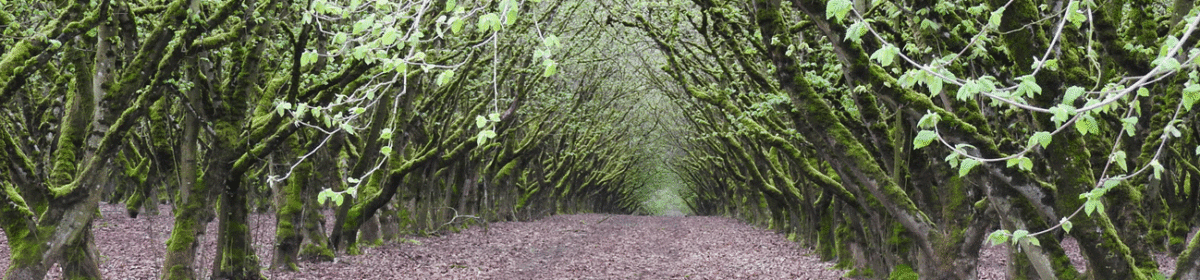
Beginning a journey into the Old Testament can feel like a ride into a dark tunnel. However, recognizing the first five books of the Bible sheds some light on the path.

How much longer in this dark tunnel?

Riding through the tunnel alternately pedaling and praying, I scooted to the side and wondered how much longer we would be traveling in darkness.

I was so grateful for the other riders, even if the sheer numbers and chaos was unsettling. I certainly benefited from the additional light in the tunnel and was grateful I was not alone.

The return journey

Some people were headed in the opposite direction up through the tunnel, as it was the only way back to the parking lot. Did I mention the return journey? At the end of the trail, riders caught a shuttle bus back to the entrance of the tunnel, but they still had to ride back through the tunnel in the opposite direction to arrive once again at the trail head and the parking lot.

So this crazy ride through the tunnel would happen one more time! I’m so glad I developed some coping skills to make it through the first time.

Whether this is your first time through the Bible or another pass through, I’d like to provide some big picture references along the way to help us with perspective, retention, and comprehension.

Old and New Testament

The Bible is divided into two main parts: the Old Testament and the New Testament. Jesus arrives in the flesh in the New Testament, but that doesn’t mean he isn’t in the Old Testament. Huh? We can let this concept remain unsettled for now.

The idea that Jesus is in the Old Testament even though he doesn’t arrive on scene until the New Testament is one of the amazing aspects of the Bible. The more we familiarize ourselves with the contents of the Bible, the more we will start to see some of these really cool references.

First five books of the Old Testament

For now, we can orient ourselves to the first five books of the Old Testament, the Pentateuch, or the books of Moses. These are also referred to as the books of the Law. Don’t worry if any or all of these terms is confusing. They’ll make sense later in the process.

Genesis – Exodus – Leviticus – Numbers – Deuteronomy

Memorize the names of these five books in order. Review the “Books of the Old Testament” from Wee Sing Bible Songs if you need to. Knowing these five by name will help us find some solid ground in the Old Testament.

Old Testament key players

Soon we’ll go deeper into the details of Genesis, but for now, here is a high level overview of the first five books of the Bible, based on key players in these books:

Genesis – God and Creation, Adam and Eve, Noah, Abraham, Isaac, Jacob, Joseph

Exodus – God and Moses

Leviticus – God, Moses, and the Israelites

Numbers – God, Moses and the Israelites

Deuteronomy – God, Moses, and the Israelites

Are you still with me? We will dive into more details in subsequent posts. For now, familiarize yourself with the names of the first five. I think you’ll find it useful.

Coping in the darkness – a guiding light

Ask my husband how the ride through the tunnel was and you will get a very different response from mine. He knew some of the history of the railroad. He noticed the markers inside the tunnel that gave clues as to how far we’d traveled or how much was left. He really enjoyed the ride through it.

I was merely focused on not falling.

His start was filled with anticipation. Mine was filled with anxiety.

Grateful for a guide

I was grateful that he rode ahead of me so I had a notion of where I was going. Farther down the trail I realized the light on my bike was pretty dim. Much of the light that guided me through the tunnel came from my husband’s bike light and that of the other riders, even the ones headed in the opposite direction.

The tunnel is 1.661 miles long and not in a straight line. There is no visible “light at the end of the tunnel” for the majority of the ride through it. I was very much “in the dark” on this journey. And it felt that way.

Making room

While trying to stay upright and going much slower than the other riders, they would pass me. Each time a bike neared, its rider would call out, “Left!” That was the signal to move over and make room for someone to sail past, but that meant scooting closer to the dreaded gutter and riding on the slanted portion of the trail. I didn’t know at the time that the path slanted in that section. I just knew peddling and steering on that part challenged me more than in the middle.

I struggled to take in the sights and enjoy this stretch of the ride because I was so focused on not crashing into the gutters or another rider.

Foxhole prayers

At one point I started to hum to distract myself. I’m sure I also started to pray. You know, one of those foxhole prayers in the moment of deep distress and need. Praying and humming was calming. When I’m not struggling to stay upright on a bike, I write worship songs and play the violin with a worship team, often creating a violin part during the service. So I drew on these skills that were comforting and familiar, and made up a melody to draw me into a place of comfort and peace.

Connecting to Jesus

This praying and music making connected me to Jesus. I no longer focused on what was worrisome, but instead on that which brought peace and calm.

I know it’s early to talk about Christmas, but it’s like when we hear the beginning of a favorite Christmas carol. It can transport us to a memory or a feeling that brings comfort and joy. A place or sense that all is calm. That’s what praying and humming did for me.

Do I remember the prayer I prayed? No, though it was probably along the lines of, “Jesus, please keep me upright on this bike and help me make it through this tunnel.” I’m guessing my prayer was even shorter as that probably would have taken too much concentration. More like short bursts of hope to grasp onto. A simple, “Jesus, help,” (which I just noticed is the first word of each of those phrases).

So whether or not you’ve prayed before, I invite you to give it a try. Take a moment and just say, “Jesus, help,” and maybe you, too, will find a place where all is calm.

Riding into the tunnel – setting the pace

So there we were facing the long dark tunnel. (Did you see the photo of it in the previous post?)

There were no lights in this tunnel. The only light came from the one attached to the bike. The ride through the tunnel was on packed dirt with loose gravel on top. (Remember what I said about my childhood experience with loose gravel?)

Inside the tunnel            

This was a recipe for disaster. And the path was flanked by gutters full of rushing water while moisture dripped down from the roof of the tunnel. And there were puddles, (or potholes as I experienced them), ready to knock me off my bike, unless I rode around them, but maneuvering around them added to the wobble. (My husband told me later he could tell I was struggling because my bike light was swerving all over the place).

So all I knew about this tunnel was that it was long and dark and the ground I was riding on felt unstable. As much as I tried to hold steady, my bike kept meandering toward the gutter. (Later I would find out that was because the path sloped on both sides to help the water drain down toward the gutters, which was certainly practical and helpful for the gutters, but not for me).

Other riders

Added to all those unhelpful factors was all the other riders in the tunnel. Some were headed in the same direction as me. I was going slower, (which I later figured out actually made the ride harder). But the lights from the other bikes also illuminated the path, making it easier to see than going it alone.

Entering the Bible

Ever look at the Bible and feel like you’re staring into a long dark tunnel? Ok, so maybe there’s a little light at the beginning of Genesis, after all, God did create light in chapter 1 verse 3. (Genesis 1:3)

But not long after it can start to feel murky and convoluted.  Especially if we go it alone.

But we’re not alone on this journey.

Start anywhere

And with the Bible, as with the path, you can start anywhere. Sure, it may feel more logical to start in some places than others, but remember, the point of reading the Bible isn’t about figuring it all out the first time we read something.

Setting the pace

Sometimes reading a section quickly helps with the understanding of it and makes the journey through a chapter or story a little smoother than plodding over each verse.

It’s fun to go back over verses slowly to catch the nuance of what’s in them and the meaning behind the words, but it really is ok to do a fast skim or read through the first time.

As with the bike ride, slower was actually harder. Once I got the hang of riding, it was easier to stay upright going faster.

So find the pace that suits you and read on.

Tunnel ahead

They say a picture’s worth a thousand words…

Receiving the map I was told I would never use.
start of Hiawatha bike ride
Staff vendor tent, official trailhead.
Smiling at the start of the bike ride.
me and my bike
Notice the mud on the tires.
The long dark tunnel ahead.
You thought I was kidding?
long dark tunnel
Now approaching 1.661 miles of St. Paul Pass Tunnel fun and games.

A shaky start – looking back at what’s familiar – childhood stories

So I’m on my bike wobbling, half walking it as I try to navigate my way over loose gravel. Now I need to back up a bit and tell you why I keep mentioning loose gravel.

Riding my bike as a kid

When I was a kid I used to ride my bike a lot. Well, after I traumatically learned how to ride it but that’s a story for another day. Once I was comfortable riding a bike, and not helplessly trying to lean in the opposite direction so I wouldn’t fall over, I was a pretty decent rider. I could cruise around the cul-de-sac no handed. I knew how to ride my bike and I no longer had to think about the mechanics of staying upright. I could take curves at a comfortable speed, ride uphill and downhill no problem. I rode my bike to work one summer and that was downhill uphill downhill on the way in and uphill downhill uphill on the way home. I was accustomed to riding a bike – a regular ten-speed on pavement and street asphalt.

So one day I was riding near a park in another neighborhood and I rode up a ramp and turned. Then crashed and burned. I learned the hard way what happens when you (or at least I) try to turn on loose gravel. I scraped my knee, limped home, and had to get the gravel out.

Back to the Hiawatha bike ride

Are you with me? So imagine what’s going through my head as I’m on a path of dirt and loose gravel. Where’s the paved road? The trail I imagined in my head? I’m not even up to that long dark tunnel and I am already confronted with my greatest biking fear. The only thing going for me is that I’m sitting on a mountain bike with really fat tires (well compared to a regular ten-speed).

But it’s been years since I’ve been on a bike. Nothing about it is familiar and I’ve just committed to a 15-mile bike ride that starts on bumpy dirt and loose gravel. What was I thinking? Whose idea was this anyway? Oh, yeah. My husband’s. And I love and trust my husband and he’s going on this bike ride with me.

Childhood Bible stories

Growing up I heard Bible stories: Noah and the Ark, Moses and the parting of the Red Sea, David and Goliath. The stories were presented on felt board. They were short and understandable. All I had to do was listen to someone else tell me the story or look at an illustrated storybook version.

The stories were recognizable, understandable, and familiar. When I tried to read the Bible as an adult, the safety net was gone. There were no pictures and the stories were a lot longer and had more details. And those names, so many difficult to pronounce names. I wanted the process to be easier, more understandable and manageable.

What we remembered

On the first gathering of my Bible study (the group that read through the whole Bible), we started with what we remembered: Bible stories from our childhood. We shared names we remembered from the Bible: Adam and Eve, Noah, Moses, David, and Jesus. In some cases we remembered a story about the people. Noah built an ark for a flood. David slew a giant Goliath.

Coming back to these stories woven in our hearts from our childhood helped us find a connection to the Bible. It gave everyone a boost of confidence as they realized they already knew something about the Bible. I remember when the epiphanies started and someone discovered they knew a story but either hadn’t realized it was from the Bible or that it was the same person in the Bible. Moses as a baby in a basket and as a grown-up with the parting of the Red Sea.

“That was Moses?”

“Yes, that was Moses.”

“Same Moses?”

“Yup, same Moses.”

Do you have stories you remember from the Bible? Start there. That’s your knowledge base. You do know something from the Bible. No stories coming to mind? Don’t worry, that’s what this journey is for, to learn about those people in the Bible. And the best part? God is in those stories and He’s with us on this journey.